
Open Design: your coding agent as a design engine
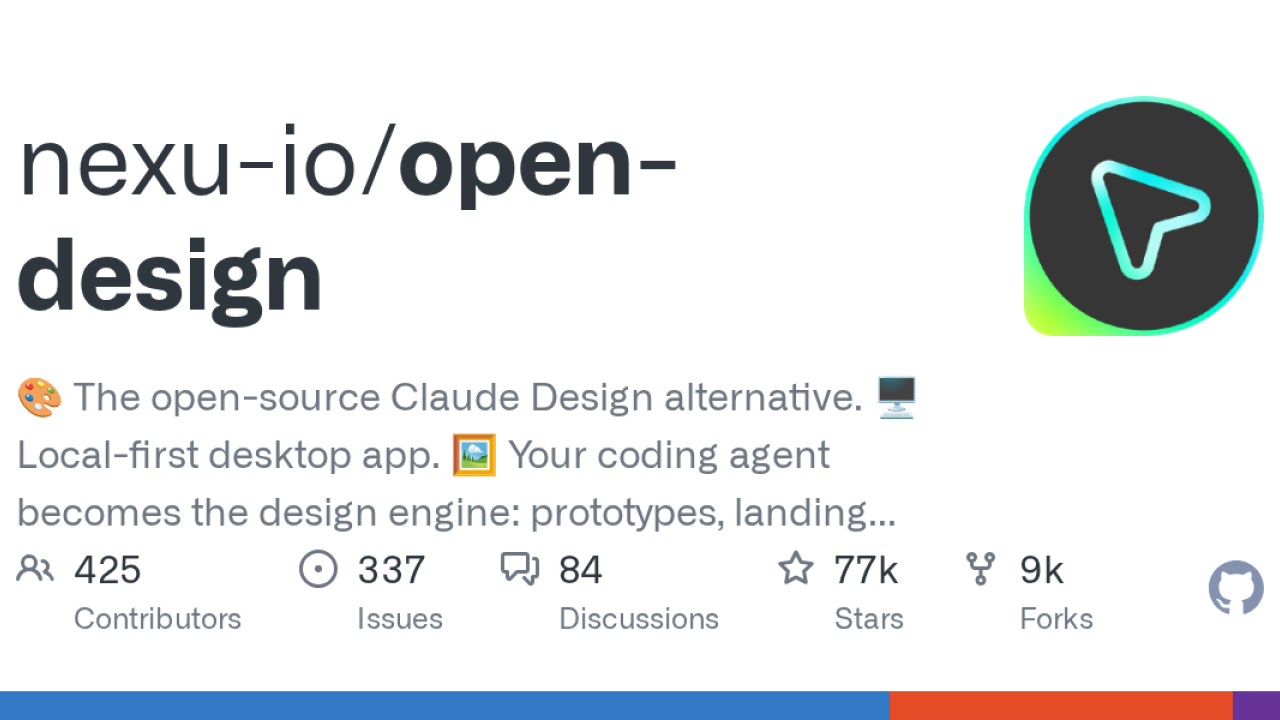
I am a PHP developer who ships Drupal by day and hand-rolls themes when a project needs one. I am emphatically not a designer. So a project calling itself "the open-source Claude Design alternative" is exactly the kind of thing I both need and distrust. I spent an evening reading the repo for Open Design by nexu-io, and here are the field notes.
What it actually is
Open Design is a local-first desktop app (macOS, Windows, and a Linux AppImage) that turns a coding agent you already have into a design engine. Instead of shipping its own model, it spawns your CLI, feeds it skills and a design system, and streams back real files: prototypes, landing pages, dashboards, slide decks, images, and even HTML-to-MP4 motion graphics. Exports land as HTML, PDF, PPTX, or MP4.
The clever bit is the file format. A brand's look lives in a portable DESIGN.md, and a workflow lives in a SKILL.md (the same convention Claude Code uses). The repo ships around 150 design systems and 100-plus skills, plus a plugin marketplace. As a Drupal person, treating a design system as a committable markdown file rather than a locked cloud document feels immediately right.
The stack, briefly
- Frontend: Next.js 16 / React / TypeScript, wrapped in an Electron shell.
- Backend: a local Node 24 daemon on Express with better-sqlite3, streaming over SSE.
- Integration: it registers as an MCP server, and a BYOK proxy talks to any OpenAI-compatible endpoint, with SSRF protection at the daemon edge.
- License: Apache-2.0, with some bundled MIT skills keeping their own terms.
It advertises support for 22-plus agent CLIs, Claude Code, Codex, Cursor, Copilot, Gemini, OpenCode and friends, so you are not locked to one vendor.
Getting started
The download-the-app route is zero-config, but the part that interested me is wiring it into an agent I already run:
od mcp install <agent>
# <agent> = claude | codex | cursor | copilot | openclaw | ...

# or build from source
git clone https://github.com/nexu-io/open-design.git
cd open-design
corepack enable && pnpm install
pnpm tools-dev run web
Then you talk to it in plain language from inside your agent, e.g. "generate a landing page with the Linear design system." Node ~24 and a specific pnpm version are required, so it is not quite drop-in for an older toolchain.
The reception, and the caveats
This is where the honesty has to come in. The project climbed the charts fast and hit the front page of Hacker News (around 232 points, 92 comments), and the thread was not a love-in. The star curve rose suspiciously linearly, which drew open accusations of bought stars, so I would not read the headline count as organic signal.
"I don't think I've ever wanted a README to fuck off more than this one."
That comment was about the marketing tone, and honestly, the README does read like a Claude-written pitch: buzzword-dense, emoji-forward, every roadmap item already ticked. The deeper critique was about the output itself, that AI design converges on the same sterile templates, the new default keynote look, so the thing that made a polished artifact a signal of effort quietly evaporates.
My take as a non-designer
I am the target user, and I am cautiously into it. For internal dashboards, a throwaway prototype, or a deck nobody will frame, "good enough and instant" is a genuine win, and I would rather own the markdown than rent a canvas. But I would not point it at anything that needs to look distinct, and I would treat the exported code as a starting draft to refactor, not something to commit as-is. The idea is strong; the hype is doing a lot of load-bearing work. I would clone it, ignore the README's tone, and judge the artifacts myself.