
Ruflo field notes: the swarm formerly known as claude-flow
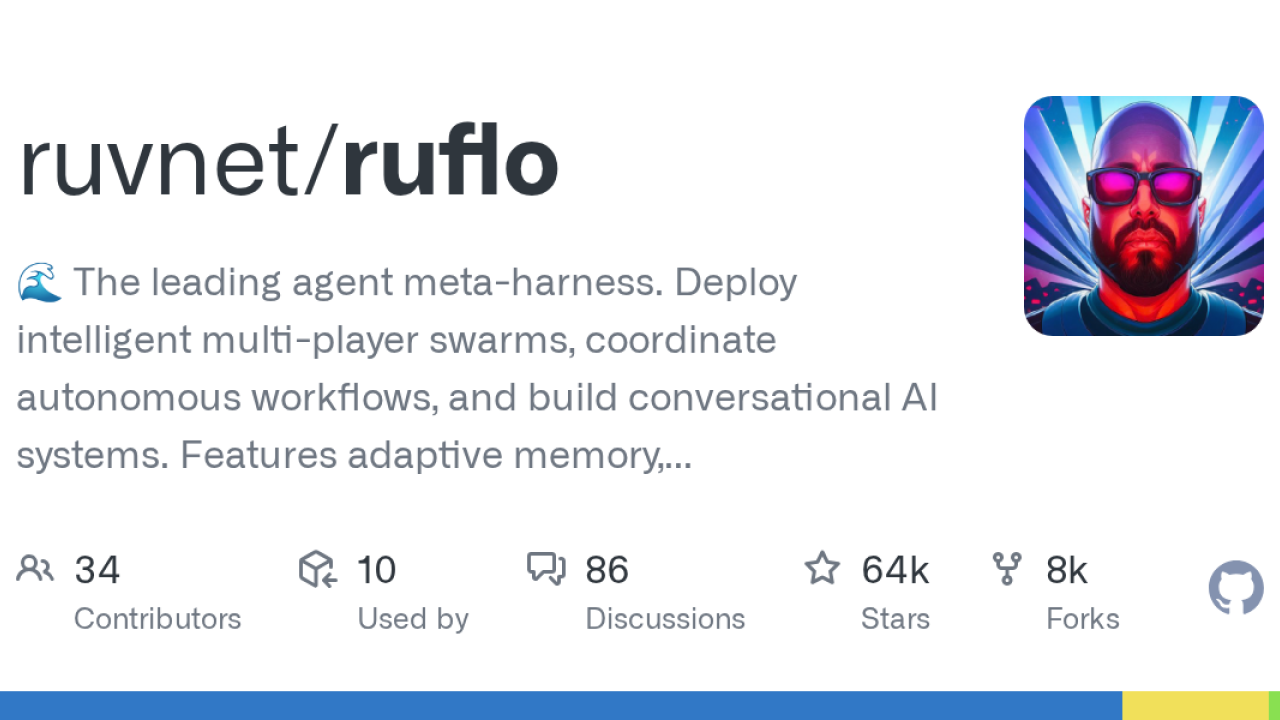
If you've been anywhere near the Claude Code corner of the internet, you've seen ruvnet's claude-flow — the multi-agent swarm project with the star count of a small JavaScript framework. As of early 2026 it has a new name: Ruflo. Same repo, same author, new identity, and apparently a new Rust-flavoured core. I spent an evening reading the README and the surrounding chatter so you don't have to.
What Ruflo actually is
Ruflo calls itself an "agent meta-harness" for Claude Code and Codex. The pitch is that the model alone isn't an agent — it needs an execution layer around it. Ruflo is that layer: it registers as an MCP server inside Claude Code and adds swarm coordination, persistent vector memory, background workers, and a frankly enormous catalogue of pre-built agents.
Agent = Model + Harness. The model writes; the harness gives it tools, memory, loops, sandboxes, and controls so it can actually work.
The rename from claude-flow happened with the v3.5 release in February 2026, appears to have been driven at least partly by trademark concerns, and coincided with an architectural shift: core pieces like the policy engine and embeddings reportedly moved from TypeScript to Rust compiled to WASM. The repo is still ~84% TypeScript, MIT licensed, and sitting just under 64k stars with a genuinely absurd release cadence — over 1,500 releases, with v3.25.6 shipping the day before I wrote this.
What's in the box
- 100+ specialized agents for coding, testing, security, docs and architecture, organised into swarms with hierarchical, mesh or adaptive topologies.
- Vector memory via AgentDB with HNSW indexing, so agents remember things across sessions.
- Self-learning through something called SONA and "ReasoningBank" trajectories — the swarm supposedly gets better at your codebase over time.
- Agent federation: agents on different machines talking to each other with zero-trust identity and PII redaction.
- Multi-provider routing across Claude, GPT, Gemini and local models via Ollama, with failover.
- Consensus protocols (Raft, Byzantine, Gossip) for swarm coordination, which is either impressive or a sign someone had fun, possibly both.
Getting it running
Installation is refreshingly boring for something this ambitious. Straight from the README:
# One-line install (POSIX shells only)
curl -fsSL https://cdn.jsdelivr.net/gh/ruvnet/ruflo@main/scripts/install.sh | bash

# All platforms (including Windows)
npx ruflo@latest init wizard

# Register as an MCP server in Claude Code
claude mcp add ruflo -- npx ruflo@latest mcp start
There's also a lighter path via Claude Code plugins (/plugin install ruflo-core@ruflo) and a hosted web UI at flo.ruv.io if you want to poke at it with zero install. Both the ruflo and legacy claude-flow npm packages currently resolve to the same version, which helps with the migration but adds to the naming soup.
My skeptic hat
Here's where I put my Drupal-day-job pragmatism on. The README claims Ruflo beats LangGraph, AutoGen and CrewAI "by 1.3×–1953×" on its own benchmark matrix. Any range that ends in 1953× makes my eyebrow do the thing. The benchmarks appear to be self-published, and independent, attributable reviews are notably thin relative to the star count — most coverage traces back to the author or to unattributed social posts.
Other honest caveats: the project appears to be dominated by a single (prodigiously productive) author, so bus factor is real. The near-daily releases are great for momentum, less great if you want a stable dependency. And the rename means a long tail of tutorials still point at claude-flow URLs, with docs mixing both names.
Would I use it?
Probably not the full hundred-agent Byzantine-consensus experience for my Drupal work — most of my tasks are "fix this form alter," not "coordinate a mesh topology." But the memory layer and the MCP integration are genuinely interesting, and npx ruflo init is a cheap experiment. My plan: try it on a sandbox module, see if the persistent memory actually helps across sessions, and report back. If a swarm of agents refactors my batch operations while I sleep, you'll read about it here. If it just burns tokens elegantly, you'll read about that too.