
Why Use Many Token When Few Token Do Trick
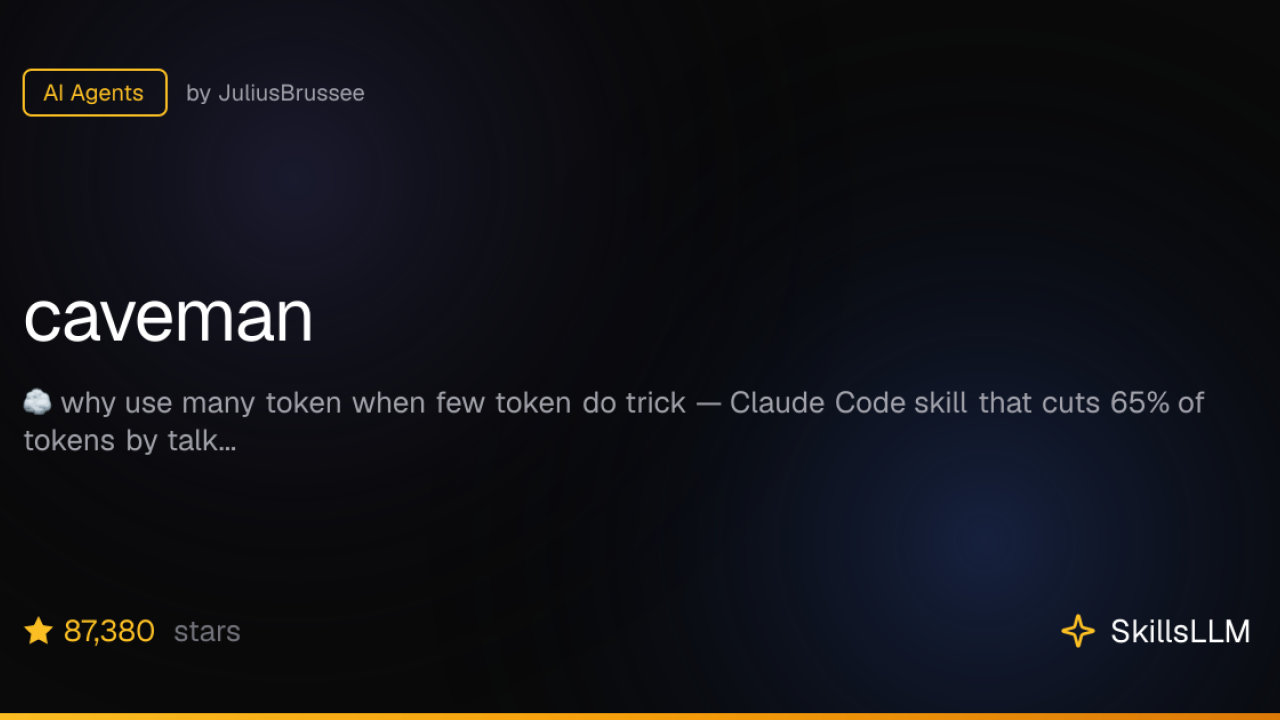
Every so often a tool lands in my feed that is one part shitpost, one part genuinely decent idea. Caveman is exactly that: an installable AI agent skill whose entire premise is making Claude (or Cursor, or Cline) stop writing warm, hedged paragraphs and start grunting at you in fragments to save output tokens. I could not resist digging in.
What caveman actually is
Caveman is an open-source Agent Skill by Julius Brussee (MIT licensed, on GitHub as JuliusBrussee/caveman). It ships a set of instructions that tell the model to compress its prose into terse, telegraphic "caveman" style while leaving code, diffs, and exact error strings completely verbatim. The pitch is a ~65% cut in output tokens with no loss of technical accuracy.
Why use many token when few token do trick.
That is the actual project tagline, and honestly it tells you everything about the vibe. It supports intensity levels: lite, full (default), ultra, and a delightfully unhinged wenyan mode that encodes answers in Classical Chinese for maximum token density. It also bundles helpers like /caveman-commit (Conventional Commits, subject under 50 chars), /caveman-review (one-line PR comments), and /caveman-compress for squeezing your memory files.
A quick detour: what Agent Skills even are
If you have not met Skills yet, they are Anthropic's format for teaching an agent a specialised capability. A Skill is just a folder with a SKILL.md file: YAML frontmatter (a name and a description) plus markdown instructions, and optionally scripts and reference files.
The clever bit is progressive disclosure. Only the frontmatter (~100 tokens) sits in context at all times. The full SKILL.md body loads when your request matches the description, and bundled files load only when actually needed. So you can install a pile of skills without drowning your context window.
---
name: caveman
description: Ultra-compressed communication mode. Cuts token
  usage by speaking like caveman while keeping technical accuracy.
  Levels: lite, full (default), ultra, wenyan.
---

# Before / after
Normal:  "The reason your component re-renders is that you create
          a new object reference on every render cycle..."  (69 tok)
Caveman: "New object ref each render. Inline prop = new ref =
          re-render. Wrap in useMemo."                      (19 tok)

# install (macOS / Linux / WSL)
$ curl -fsSL https://raw.githubusercontent.com/JuliusBrussee/caveman/main/install.sh | bash
Installing and driving it
- Install: the curl one-liner above, or
npx skills add JuliusBrussee/caveman -a cursorfor other agents. Needs Node 18+, takes about 30 seconds. - Toggle:
/caveman full,/caveman ultra, and so on. - Measure:
/caveman-statsreports the session's claimed savings. - Pre-compress:
/caveman-compress CLAUDE.mdrewrites a memory file (they claim ~46% input reduction) and keeps a readable backup.
Does it actually save tokens?
Here is where my inner skeptic perked up, and thankfully someone did the homework. JetBrains ran a proper A/B test: 82 paired real coding tasks, Claude Sonnet 5, 240+ billed trials. Advertised saving: 65%. Measured saving with the skill force-activated: 8.5% of output tokens.
The reason is boringly logical. Agentic output is mostly code, file edits, and tool calls, all of which caveman correctly leaves untouched. Only the narration between tool calls gets crushed, and there is not much of it. Quality, encouragingly, stayed statistically indistinguishable (p = 0.82). Their verdict: "safe, honest about style, oversold on savings."
Two more honest caveats worth keeping in your head:
- The skill itself adds roughly 1 to 1.5k input tokens per turn, so whole-session accounting shrinks the win further.
- The eye-popping 80%+ numbers come from chatty prose explanations, which is the least common thing a coding agent produces.
So would I use it?
For pure cost savings on Drupal work? No. My agent output is diffs and PHP, not TED talks. But I might keep /caveman-review around, because one-line PR feedback is genuinely nicer to skim, and there is a real ergonomic case for a terser default voice. Treat the 65% as marketing, enjoy the 8.5% and the grunts, and appreciate it for what it really is: a very funny, surprisingly well-built demonstration of how the Skills format works.